


As the upcoming election season enters the final stretch, it’s easy to get caught up in the emotions surrounding the candidates and outcomes. Election season often brings uncertainty, and it's natural to wonder what impact a new administration might have on the economy and markets. However, it’s important to remember that historically, markets have demonstrated resilience under both political parties. Instead of focusing on who wins or loses, the more crucial factor for investors is to stay focused on corporate and economic fundamentals, which remain strong.
Historical Perspective: Markets Under Both Parties
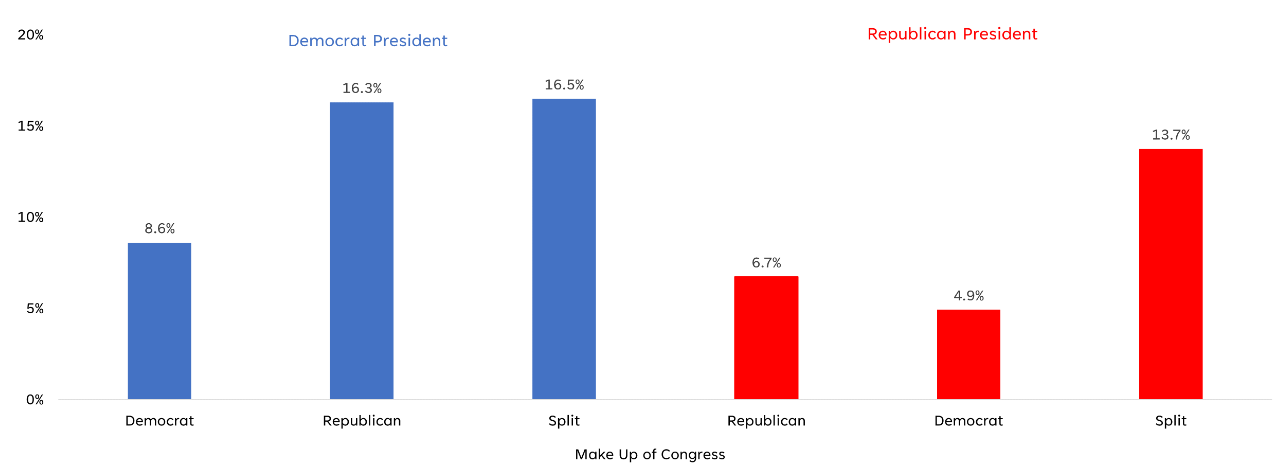
Since 1950, the S&P 500 has delivered positive returns under both Democratic and Republican presidents, as shown in the chart below. Average returns have remained resilient regardless of which party holds the presidency. This reflects the market’s adaptability and focus on broader economic trends over political shifts.
Chart. Average S&P 500 Annual Return (1950 – 2024 YTD)
Source: LPL Research, Bloomberg 11/10/2022
Disclosures: Data are from 1950–2021. All indexes are unmanaged and cannot be invested into directly. Past performance is no guarantee of future results. The modern design of the S&P 500 stock index was first launched in 1957. Performance back to 1950 incorporates the performance of predecessor index, the S&P 90.
These numbers suggest that markets may perform best when there is a balance of power, as seen with a split Congress, where returns have historically been higher. Ultimately, fundamentals like corporate earnings, consumer spending, and Federal Reserve policies continue to play a more significant role in driving market performance than the party in office.
Strong Fundamentals Support Market Resilience
The market’s resilience is bolstered by solid economic fundamentals. Key indicators—including corporate earnings, GDP growth, labor market stability, consumer spending and recent Federal Reserve actions—highlight a strong economic foundation:
- Resilient Corporate Earnings: As of October 25th, approximately 35% of companies have reported third-quarter earnings, with 75% exceeding earnings estimates and 59% surpassing revenue expectations. FactSet reports a blended revenue growth of 4.9%, suggesting that revenue is outpacing inflation—a sign of healthy sales and consumer demand.[1]
- Steady GDP Growth: The advanced estimate for Q3 GDP growth came in at 2.8%, following a 3.0% increase in Q2[2]. This sustained growth points to a healthy economic trajectory, despite fluctuating interest rates and election uncertainties.
- Stable Labor Market: The ADP jobs report for October revealed that private companies hired 233,000 workers, marking the strongest month for job growth since July 2023[3]. Stable job creation reflects a resilient labor market that continues to support consumer spending.
- Possible Housing Market Rebound: The National Association of Realtors reported a 7.4% increase in pending home sales for September, the highest level since March. The association anticipates further home sales growth in 2024 and 2025, a positive signal for a key economic sector[4].
- Healthy Consumer: U.S. retail sales rose by 1.7% year-over-year in September[5] and the most recent GDP report indicated consumer spending grew at a 3.7% annualized rate in the third quarter[6], reflecting a strong consumer base. With consumer spending comprising roughly 70% of GDP, this strength is vital for economic stability and growth.
- Inflation Easing Towards Fed’s 2% Target: The consumer price index (CPI) increased by 2.4%[7] in September, while the Federal Reserve’s preferred measure, the Personal Consumption Expenditures (PCE) index, rose by 2.1%[8]. Lower inflation helps maintain consumer purchasing power and supports corporate profit margins.
- Federal Reserve Rate Cuts: In September, the Federal Reserve cut rates by 50 basis points, and additional cuts are expected as inflation continues to ease. Lower rates reduce borrowing costs, which can stimulate consumer spending and corporate investment.
These strong fundamentals suggest that, regardless of the election outcome, the economy remains well-positioned to support market performance. Investors should stay focused on these indicators rather than the short-term noise of the election cycle.
Stay Invested: Long-Term Success Hinges on Patience
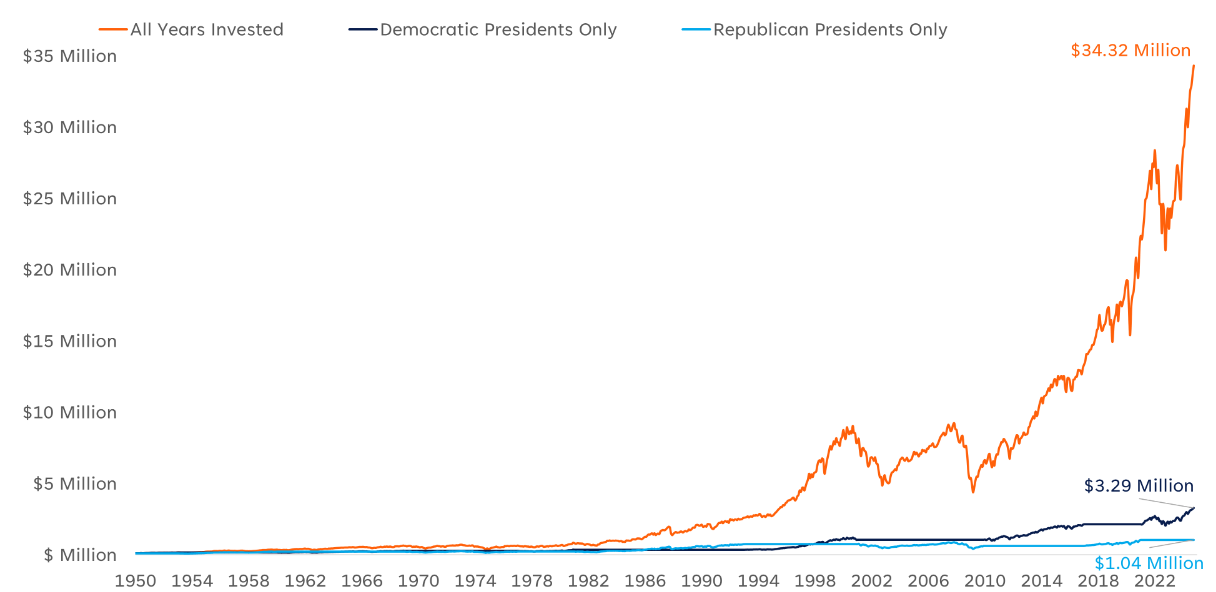
For investors tempted to liquidate their portfolios based on election results, history offers a valuable lesson. The second chart illustrates that staying invested is the best path to long-term growth. Over time, those who remained in the market have benefited from compounding returns, with $10,000 invested in 1949 growing to over $34 million today. The growth trajectory is especially evident since 2008. Selling based on political shifts often results in missed growth opportunities and the potential for lower returns over time.
Chart. Hypothetical Return of $10,000 Invested in 12/31/1949
Source: Source: LPL Research, Bloomberg 06/24/24
Disclosures: Past performance is no guarantee of future results. All indexes are unmanaged and can’t be invested in directly. The modern design of the S&P 500 stock index was first launched in 1957. Performance back to 1950 incorporates the performance of the predecessor index, the S&P 90.
Conclusion
The key takeaway for investors during election season is clear: focus on the factors that truly drive market success – earnings growth, economic stability, consumer strength and Federal Reserve policy. While it's natural to have opinions on the election, your portfolio is best served by remaining grounded in these fundamentals and maintaining a long-term perspective.
As we’ve discussed in previous posts on election-year volatility and Federal Reserve rate cuts, staying invested is critical for meeting your financial goals. Rather than reacting to short-term election headlines, remember that a diversified portfolio built around strong fundamentals is your best strategy for long-term success.
If you’re interested in more insights about the election and markets, please see LPL’s Election Insights Brochure.
Content in this material is for general information only and not intended to provide specific advice or recommendations for any individual. All performance referenced is historical and is no guarantee of future results. All indices are unmanaged and may not be invested into directly.
All investing involves risk including loss of principal. No strategy assures success or protects against loss. There is no guarantee that a diversified portfolio will enhance overall returns or outperform a non-diversified portfolio. Diversification does not protect against market risk.
The economic forecasts set forth in this material may not develop as predicted and there can be no guarantee that strategies promoted will be successful.
[1]FactSet Earnings Insight, October 25, 2024. Available at: https://advantage.factset.com/hubfs/Website/Resources%20Section/Research%20Desk/Earnings%20Insight/EarningsInsight_102524.pdf
[2]U.S. Bureau of Economic Analysis, Gross Domestic Product, Third Quarter 2024 (Advance Estimate). Available at: https://www.bea.gov/news/2024/gross-domestic-product-third-quarter-2024-advance-estimate
[3]ADP National Employment Report. Available at: https://adpemploymentreport.com/
[4]National Association of Realtors, Pending Home Sales Advanced 7.4% in September. Available at: https://www.nar.realtor/newsroom/pending-home-sales-advanced-7-4-in-september
[5]U.S. Retail Sales Increase Solidly in September, Reuters, October 17, 2024. Available at: https://www.reuters.com/markets/us/us-retail-sales-increase-solidly-september-2024-10-17/
[6]U.S. Economy Posts Solid Growth on Election Eve, Reuters, October 30, 2024. Available at: https://www.reuters.com/markets/us/us-economy-posts-solid-growth-election-eve-2024-10-30/
[7]U.S. Bureau of Labor Statistics, Consumer Price Index News Release. Available at: https://www.bls.gov/news.release/cpi.nr0.htm
[8]U.S. Bureau of Economic Analysis, Personal Income and Outlays, September 2024. Available at: https://www.bea.gov/news/2024/personal-income-and-outlays-september-2024