


Markets have had plenty to digest over the past several weeks. Weakness in September and October carried into November as investors weighed the election results, concerns about the AI investment cycle, and the possibility that persistent inflation could keep interest rates elevated. With several of the market’s strongest performers experiencing substantial declines, it is understandable that investors are questioning whether the outlook has changed.
While these developments deserve attention, the economic and earnings data present a more balanced picture than the recent selling might suggest. Corporate earnings continue to grow, valuations have become more reasonable, and recent selling has reduced some of the speculative excess that contributed to bubble concerns earlier in the year. The path through year end may remain uneven, but we believe the underlying fundamentals provide reasons to look beyond the recent volatility.
What Is Behind the Selling
Although the election became a catalyst for renewed uncertainty, the selling began well before the results were known. Throughout October, large investment funds were reducing exposure, particularly in AI related stocks where many investors had accumulated similar positions. As those trades reversed, efforts to reduce borrowed exposure, a process known as deleveraging, added downward pressure to prices.[1]
Morgan Stanley reported that November 5 brought one of the largest daily declines in hedge fund net leverage since 2010.[2] When funds reduce risk simultaneously, stock prices can move much faster than the outlook for the companies themselves, helping explain some of the unusually sharp swings.
We believe this process has relieved some of the crowding and enthusiasm that fueled bubble fears. That does not establish that the selling is over, but it helps explain why falling share prices do not necessarily signal a comparable deterioration in business conditions.
Earnings Continue to Provide Support
As we have discussed in previous updates, corporate earnings remain central to our outlook. According to FactSet’s November 6 report, with 88% of S&P 500 companies having reported, blended third quarter earnings growth stood at 31.4%. All eleven sectors were reporting growth, suggesting that improving profits extend beyond a handful of large technology companies.[3]
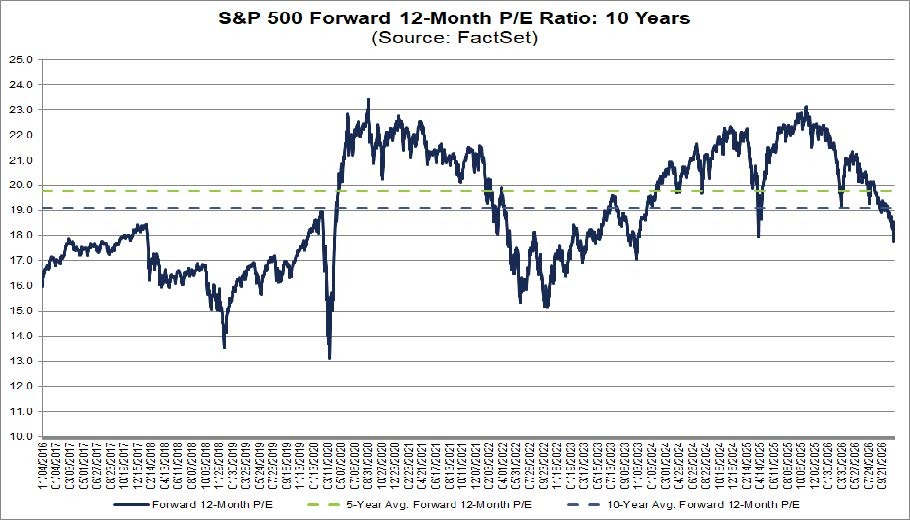
What is particularly encouraging is how that earnings strength has changed valuations. At the beginning of the year, the S&P 500 traded at approximately 22 times expected earnings over the following twelve months. By November 5, that figure had declined to 17.7, below its averages over five and ten years, as earnings expectations increased faster than stock prices.[4]
Chart 1: Forward Price to Earnings relative to 5-Yr and 10-Yr Averages
Source: FactSet
In other words, expected earnings have increased faster than stock prices, bringing the market’s forward valuation down. The combination of rising earnings expectations and a lower forward price to earnings ratio helps ease concerns that prices have become disconnected from business performance. Forecasts still need to be met, and valuations remain above some longer term averages, but the earnings picture provides a stronger foundation than the recent headlines might suggest.[5]
Has the AI Investment Story Changed
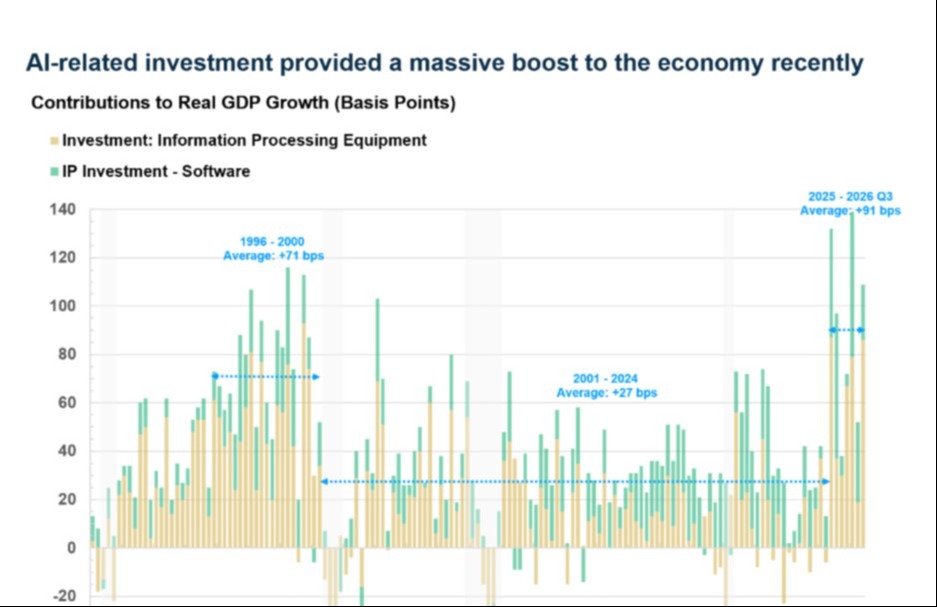
The election has brought greater scrutiny to data center construction, including electricity costs, water use, permitting, and the benefits these projects provide to local communities.[6] Those concerns could slow development, but the buildout also supports construction jobs, equipment manufacturing, and investment in power infrastructure. As technology spending has become a larger contributor to economic growth, policymakers face the challenge of addressing community concerns while preserving the jobs and economic benefits these projects can bring.[7]
Chart 2: AI-Related Investment Contribution to GDP
Source: Carson Investment Research, via Ryan Detrick, CMT, on X, November 2, 2026.
The sharp selling in AI investments suggests that markets may be anticipating a more lasting setback, when the outcome could be a delay in spending rather than an end to the investment cycle. Spending forecasts remain substantial, although permitting and power constraints could push some projects into later years.[6] Delays still matter, particularly for suppliers awaiting orders and developers paying interest before facilities generate revenue. However, a slower construction schedule has different implications for economic growth and corporate earnings than a collapse in demand. The distinction will become clearer as companies update their spending plans and policymakers move from campaign proposals to implementation.
Inflation Remains a Challenge
While earnings remain encouraging, inflation continues to complicate the outlook for interest rates. Through September, year over year CPI inflation had exceeded 2% in 66 reported monthly observations, a stretch extending back more than five years.[8] The latest report offered limited reassurance: October consumer prices rose 0.4%, following September’s 0.6% increase, while prices excluding food and energy increased 0.3%.[9]
Inflation’s persistence suggests that interest rates could remain elevated longer than investors previously expected. At the beginning of the year, expectations centered on rate cuts, but the discussion has since shifted toward further increases, potentially extending into 2027.[10] That reversal helps explain some of the pressure on stock valuations: even as companies deliver stronger earnings, higher interest rates can reduce what investors are willing to pay for those profits.
Lower energy prices would help, but the Fed will need broader evidence that inflation is easing sustainably. Resilient employment and consumer spending support continued growth, while reducing the urgency to lower rates. Over time, productivity gains from AI could help businesses expand without adding as much inflationary pressure, but those benefits will take time to develop.[11] For now, continued earnings growth and moderating inflation would provide a more favorable backdrop for markets.
Putting the Market Moves in Perspective
Looking toward year end, stronger earnings and lower valuations provide a counterweight to policy uncertainty and persistent inflation. History offers some encouragement as well: since 1950, the S&P 500 has been positive in all 19 twelve-month periods following midterm elections, with an average gain of 15.1%.[12] That record does not guarantee another positive outcome or predict returns through December, but it provides perspective on how markets have moved beyond previous election cycles.
The developments that could weaken this picture include falling earnings expectations, a meaningful slowdown in employment and investment, or inflation that keeps interest rates moving higher. We will also be tracking corporate bond spreads, which measure the additional yield investors demand to lend to companies rather than the U.S. Treasury. A sustained widening in those spreads could signal growing concern about companies’ financial health and broader economic conditions.
So, what has changed? The election has brought renewed attention to several market narratives, but the fundamentals present a more balanced picture than the headlines might suggest. Stronger earnings, lower valuations, and continued business investment remain important sources of support, even as inflation and interest rates warrant attention. Our focus remains on those fundamentals and how they evolve, while keeping political developments and market volatility in perspective alongside long term financial goals.
Content in this material is for general information only and not intended to provide specific advice or recommendations for any individual. All performance referenced is historical and is no guarantee of future results. All indices are unmanaged and may not be invested into directly.
All investing involves risk including loss of principal. No strategy assures success or protects against loss.
The economic forecasts set forth in this material may not develop as predicted and there can be no guarantee that strategies promoted will be successful.
Stock investing includes risks, including fluctuating prices and loss of principal. Any company names noted herein are for educational purposes only and not an indication of trading intent or a solicitation of their products or services. LPL Financial doesn’t provide research on individual equities.
[1]Morgan Stanley Derivatives, market positioning update, November 6, 2026, citing Morgan Stanley Prime Brokerage and Quantitative Derivatives Strategies. x.com
[2]Morgan Stanley Derivatives, market positioning update, November 6, 2026, citing Morgan Stanley Prime Brokerage and Quantitative Derivatives Strategies. x.com
[3]John Butters, Earnings Insight, FactSet, November 6, 2026, pp. 1 and 6–7. “Blended” growth combines reported earnings with estimates for companies yet to report. insight.factset.com
[4]John Butters, “Lowest Forward 12-Month P/E Ratio for the S&P 500 in More Than 3 Years,” FactSet, November 9, 2026. Valuations and year-to-date comparisons are as of November 5. insight.factset.com
[5]John Butters, “Lowest Forward 12-Month P/E Ratio for the S&P 500 in More Than 3 Years,” FactSet, November 9, 2026. Valuations and year-to-date comparisons are as of November 5. insight.factset.com
[7]Jeffrey Roach, Economic Navigator: The Buildout Continues, But the Risks Are Rising—Client Summary, LPL Research, November 4, 2026, p. 1. Productivity benefits are prospective and may not develop as expected. lpl.com/research
[8]Year-over-year CPI inflation count through September 2026, reported by The Wall Street Journal, October 14, 2026. wsj.com
[9]U.S. Bureau of Labor Statistics, “Consumer Price Index—October 2026,” November 10, 2026. Monthly changes are seasonally adjusted. bls.gov
[10]Reuters, “Fed to raise rates once more in December as inflation risks stay high,” November 10, 2026; CME Group, “Comparing 2026 Macro Signals With Past Rate-Hike Cycles,” October 2026. Rate expectations are forecasts and can change. cmegroup.com
[11]Jeffrey Roach, Economic Navigator: The Buildout Continues, But the Risks Are Rising—Client Summary, LPL Research, November 4, 2026, p. 1. Productivity benefits are prospective and may not develop as expected. lpl.com/research