


After a strong start to the year, markets have recently taken a pause. The S&P 500 has recently pulled back just over 10% from its all-time high, officially entering correction territory — a normal part of long-term investing. This marks the fifth-fastest 10% decline in the past 75 years, a sharp reminder of how quickly market sentiment can shift.[1]
Today, markets are grappling with a range of concerns: slowing economic data, rising unemployment, persistent inflation pressures, government shutdown risks, geopolitical tensions, and renewed fears over tariffs and trade policy. It's understandable that investors may wonder whether now is the time to step aside. But history tells us that staying invested during uncertain times is essential to long-term success.
Tariffs and Economic Uncertainty
Among the current challenges, tariffs have emerged as a leading concern. While some market choppiness was expected in 2025, few anticipated the degree to which the Trump administration would double down on tariffs. Unlike during the first term, when tariff threats were often softened after market reactions, this time the administration appears more resolute.
Although tariffs may aim to encourage domestic production and enhance national security, they also create significant uncertainty, making it harder for businesses to plan and for economists to forecast growth. While recent actions on tariffs may be concerning, it is too early to tell what their ultimate impact will be — especially given the on-and-off nature of the negotiations and possibility that these moves are part of a broader negotiating tactic.
Valuations, Consumer Caution, and Growth Outlook
After two strong years of market gains, valuations had become stretched, and now, combined with inflation concerns and falling stock prices, consumer spending could weaken further — a dynamic known as the negative wealth effect.
While an imminent recession is not our base case scenario, slowing consumer spending and job growth have added to near-term economic concerns.
Investor Sentiment: If You’re Feeling Cautious, You're Not Alone
If recent volatility has you feeling uneasy, you're not alone. Investor sentiment is now among the most bearish on record. According to the AAII (American Association of Individual Investors) Sentiment Survey, bearish sentiment has surged to nearly 59%, almost double its historical average.[2]
Over the past three weeks, the average bull-bear spread — the gap between bullish and bearish sentiment — has been -0.40, placing it in the 0.10th percentile of all historical readings, meaning this level of pessimism has only been seen 0.1% of the time since tracking began. Even during the 2008–2009 financial crisis, sentiment wasn’t this extreme.
The CNN Fear & Greed Index has also dropped into "Extreme Fear", confirming widespread caution.[3]
Although it's natural to reset expectations, markets can overreact when fear takes hold, often pricing in worst-case scenarios. Historically, periods of extreme bearish sentiment like this have often been followed by rebounds as clarity returns.
Why Staying Invested Is Important
With so much uncertainty, why not move to the sidelines and wait for the dust to settle? History shows that staying invested is key to long-term success — and trying to time the market often does more harm than good.
1. 10% Corrections Are Normal — and Happen Nearly Every Year
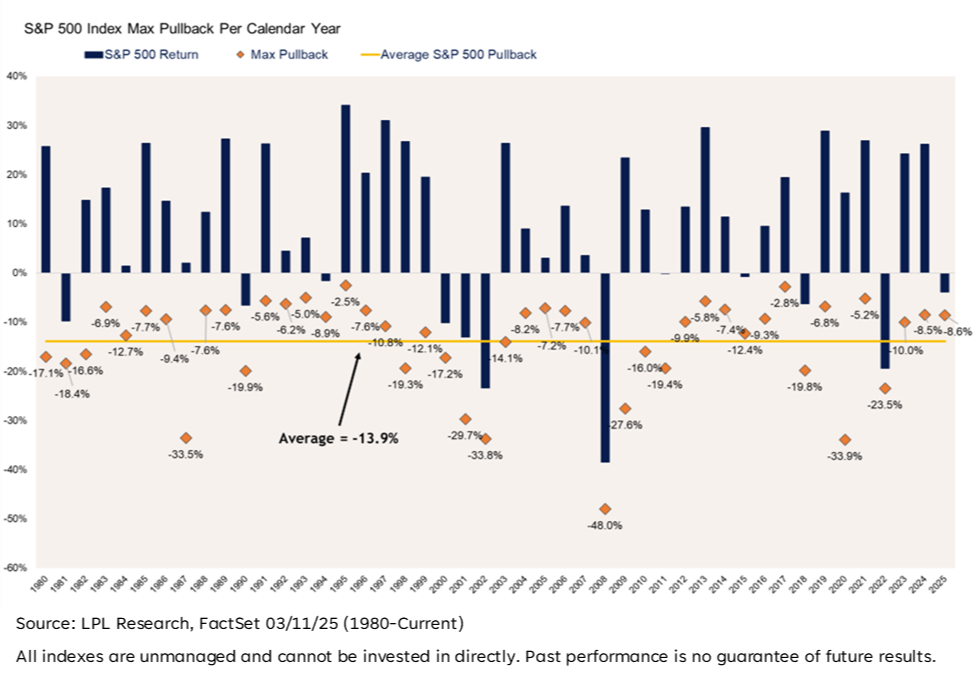
Market corrections of 10% or more are a normal part of investing, happening about once a year on average. In fact, the S&P 500 experiences an average intra-year pullback of -13.9%.[4] Staying invested through these periods is essential to achieving long-term returns.
Chart. S&P 500 Max Pullback per Calendar Year (1980-present)
2. The High Cost of Missing the Best Days
Markets often rebound swiftly, and missing just a few of the best days can significantly hurt returns. Research from Tom Lee of FS Insight highlights:
- Since 1928, the S&P 500 has averaged 8% annual returns.
- Missing the 10 best days each year would turn that into an average loss of -13%.
- Since 2015, missing the best days would have turned a 12% gain into a -10% loss.
In addition, a Dalbar study shows that investors trying to time the market tends to underperform by about 5% per year, often because of emotional decisions.[5]
3. Patience and Perseverance: Keys to Long-Term Investing
Even though market pullbacks are uncomfortable, patient investors have consistently been rewarded. As noted in The Power of Patience in Long-Term Investing:
- Rolling 1-year S&P 500 returns average 12.2%, with 75% of periods ending positive.
- Rolling 5-year returns average 10.8%, with nearly 89% of periods positive.
Staying invested through volatility is essential — markets recover, and long-term discipline pays off.
Reasons for Optimism
Despite recent headlines, there are several potential catalysts that could help stabilize markets:
- Clarification on tariffs and trade policy, especially with new tariffs set to take effect in April.
- A potential ceasefire between Ukraine and Russia, which would ease geopolitical tensions.
- A government funding bill to avoid a shutdown.
- Deregulation and tax cuts, providing fiscal stimulus.
- Expected interest rate cuts, offering support to consumers and businesses.
Maintain Discipline
We understand that market volatility is unsettling, but staying invested and following your long-term plan is the best course of action. Having a diversified portfolio tailored to your goals helps weather turbulent markets without making reactive decisions.
Corrections are a normal part of investing, and while todays’ challenges – from tariffs to slowing growth and heightened investor fear – are real, history has shown that patient, disciplined investors are better positioned to achieve their long-term objectives.
Content in this material is for general information only and not intended to provide specific advice or recommendations for any individual. All performance referenced is historical and is no guarantee of future results. All indices are unmanaged and may not be invested into directly.
All investing involves risk including loss of principal. No strategy assures success or protects against loss.
The economic forecasts set forth in this material may not develop as predicted and there can be no guarantee that strategies promoted will be successful.
[1] Lee, Tom. FSI FIRST WORD: The 20-day 10% correction in S&P 500 is 5th fastest in past 75 years. 5 prior declines were similar "knee jerk". Received by Joe Vidmar, 12 Mar. 2025.
[2] American Association of Individual Investors. AAII Sentiment Survey: Pessimism Climbs. AAII, https://www.aaii.com/sentimentsurvey#:~:text=AAII%20Sentiment%20Survey:%20Pessimism%20Climbs%20Bullish%20sentiment,been%20below%2020%%20for%20three%20straight%20weeks. Accessed 14 Mar. 2025.
[3] CNN Business. Fear & Greed Index. CNN, https://www.cnn.com/markets/fear-and-greed. Accessed 14 Mar. 2025.
[4] LPL Research. "Invest for the Long Term." LPL Financial, https://www.lpl.com/research/blog/invest-for-the-long-term.html. Accessed 13 Mar. 2025.
[5] LPL Research. "Invest for the Long Term." LPL Financial, https://www.lpl.com/research/blog/invest-for-the-long-term.html. Accessed 13 Mar. 2025.